
Because in healthcare, trust is not promised — it is certified.
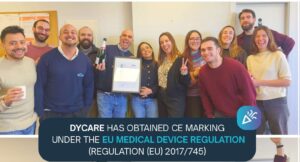
DyCare has formally obtained CE certification under the European Medical Devices Regulation (MDR, Regulation (EU) 2017/745) for its ReHub platform, becoming one of the first European digital rehabilitation platforms certified as Class IIa medical device software.
This milestone does more than validate the technology: it confirms DyCare’s commitment to patient safety, clinical evidence, and responsible innovation.
What does the CE marking really mean?
The CE marking is not a symbolic label, but a formal declaration of conformity with the most stringent European Union requirements regarding safety, effectiveness, and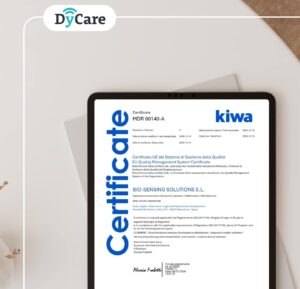 clinical performance.
In the case of medical software, such as digital rehabilitation platforms, this process involves:
Clinical validation and risk management in accordance with ISO 14971
Compliance with the software lifecycle requirements under IEC 62304
Comprehensive technical documentation
And, in most cases, an audit conducted by an independent Notified Body
Only products that successfully pass these stages may be legally marketed in Europe as medical devices.
And only these products ensure that technology truly serves the real well-being of people.
In digital health, the CE mark separates promise from evidence
The rapid growth of digital health has brought thousands of applications that claim to improve patients’ lives. However, only those that diagnose, monitor, treat, or prevent disease fall within the scope of the MDR and must be certified as Software as a Medical Device (SaMD).
For healthcare professionals and hospitals, this certification is not optional:
it represents traceability, patient safety, and regulatory compliance.
In a sector where trust is built on facts, the CE marking has become the standard that distinguishes validated solutions from purely aspirational ones.
Institutional responsibility and long-term viability
Healthcare institutions that currently implement medical solutions still operating under MDR transitional periods are assuming a significant risk.
These solutions must fully comply with the MDR by 31 December 2028. Otherwise, they will no longer be allowed to be used or commercialized within the EU.
If a solution fails to obtain MDR certification on time, the institution will have invested in a technology that is not viable in the medium to long term, jeopardizing:
Continuity of clinical services
Financial and operational investment
The organizational transformation effort associated with the project
Choosing technologies already certified under the MDR is therefore not just a technical or regulatory decision—it is a strategic choice for sustainability, legal certainty, and protection of both public and private investment.
DyCare: among the first in Europe to achieve MDR certification
DyCare formally obtained its MDR certificate in January 2026, after successfully passing the Stage 2 audit conducted by Kiwa Cermet Italia SpA (Notified Body 0476).
Its platform is now fully authorized as Class IIa medical software, designed to support personalized rehabilitation programs across four key clinical areas:
Musculoskeletal (MSK): patients recovering from surgery (joint replacements, arthroscopies) or traumatic injuries
Neurological: patients regaining mobility and function after stroke or other neurological disorders
Respiratory: patients strengthening respiratory muscles following chronic or infectious diseases
Oromotor: patients with dysphagia, speech disorders, or impaired oral mobility requiring guided therapeutic exercises
According to official sources and recent analyses (EHTEL, Digital Therapeutics and MDR: State of Play, 2024; Emergo by UL, MDR Certification Tracker for SaMD, 2025), DyCare is among the first European platforms certified under the MDR, and likely the first specialized in neuromusculoskeletal rehabilitation in both clinical and remote settings.
“Less than 10% of rehabilitation software in Europe has completed its transition to the MDR.”
— Emergo by UL, 2025
In this context, DyCare positions itself as one of the first—and very likely the first—platform specialized in comprehensive rehabilitation (MSK, neurological, respiratory, and oromotor) to achieve MDR certification.
What this milestone means for the future of rehabilitation
With MDR certification, ReHub moves beyond being a complementary tool to become a legitimate therapeutic modality. It can now:
Be formally integrated into clinical care pathways
Be prescribed by healthcare professionals
Become part of hospital protocols and reimbursement programs
Participate in multicenter clinical studies that strengthen the scientific evidence for telerehabilitation
Leading with evidence: The DyCare advantage
Holding the CE mark under the MDR allows DyCare to raise the standard of the sector and offer:
Institutional trust: hospitals, clinics, and insurers prioritize solutions with full regulatory backing
Market access: DyCare consolidates its position while other products face withdrawal due to non-compliance
Legal and reputational protection: certification ensures traceability and reduces clinical and regulatory risk
In an environment where reliability is earned through evidence, DyCare demonstrates that responsible innovation is the only sustainable innovation.
A certification that sets the direction
The CE marking under the MDR is not a bureaucratic formality:
it is the confirmation that technology can be rigorous, safe, and deeply human.
At DyCare, this achievement reinforces our mission to improve people’s lives through safe, personalized, and evidence-based digital therapies.
Because in healthcare, not everything goes.
And at DyCare, trust is built on science.
Discover how DyCare is driving the new era of safe, evidence-based digital rehabilitation:
Learn more about ReHub → Scientific evidence