
- What is camera detection?
- What does camera detection measure?
- What are the benefits of using artificial intelligence in rehabilitation?
Artificial intelligence is revolutionizing the world! In the last month, it has become clear that artificial intelligence is here to stay and transform the way we live and work. A proof of this is the increase in the use and popularity of tools such as Dalle-2 and ChatGPT. These technological advances are changing the game in a variety of industries, it is exciting to see what the future holds with this technology!
The truth is, this tool can help us make more efficient decisions, automate routine tasks, and create new opportunities and experiences. The fields of artificial intelligence are varied and range from natural language processing, robotics and camera-based motion detection.
During the COVID pandemic we saw many computer solutions that talked about recognizing body movement using “Computer Vision”, but what does this CV mean? What are your limitations?
What does Computer Vision mean?
It is a rapidly growing artificial intelligence (AI) research field that focuses on teaching computers to “see” the world around them. Camera motion detection technology, or computer vision, focuses on digital acquisition, analysis and understanding of images and videos. This technology can be used to automatically detect and identify objects and people, follow their movements, and recognize patterns.
It has already been used to create autonomous driving cars, facial recognition systems and even medical diagnostic software.
Artificial intelligence (AI) has revolutionized the health sector and it was only a matter of time before it did so in the practice of physiotherapy. Researchers have been using camera detection for years to help recover people with disabilities and injuries. Smartphones when it has become popular.
Computer Vision technology consists of using camera detection algorithms to follow the progress of the patient during physical therapy and other rehabilitation tasks. The objective is to provide information to the therapist and the patient in real time and to be able to monitor the progress of the patient in his attempt to regain functionality. providing them with valuable information on the evolution of the patient. By providing critical patient performance information, therapists can better tailor the exercises to the individual needs of the patient.
The success of this technology is largely due to the availability of increasingly powerful devices, such as smartphones, which have calculation characteristics and high-resolution cameras that allow this process to be carried out transparently for the user.
What does camera detection measure?
How does “computer vision” recognize the human body and its pose? How do you get machines to understand human movement when there are so many variables involved?
In the world of computer vision, the human body is one of the most unpredictable elements. But there is a computer vision area that deals with identifying and predicting the position and orientation of a human body within a given image or frame of video. The estimation of the human pose is the science that consists of identifying where all the parts of a person’s body are found in relation to others and with the environment that surrounds them.
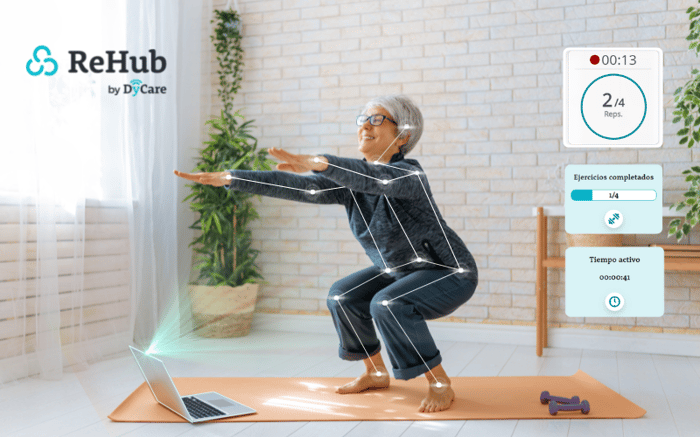
In physiotherapy, computer vision can be used to analyze posture, range of motion, and a patient’s gait. One of the most promising applications of computer vision in physiotherapy is the use of a platform that can follow the evolution of a patient over time.
DyCare has created ReHub, a digital rehabilitation platform that allows you to follow the patient during the execution of his exercises and help the professional in his monitoring. ReHub has a library of IA IA-guided exercises using science High Performance Computing (high performance computing), allowing to provide a true feedback in real time to the patient about how he is doing the exercises, correcting errors and congratulating the patient when he performs them correctly. These features help rehabilitation professionals provide a level of care that is as efficient and personalized as if the physiotherapist himself was at the patient’s home.
Benefits of using camera vision in rehabilitation
- Greater diagnostic accuracy: Computer vision can help physiotherapists identify and diagnose problems more accurately.
- Better patient follow-up: By using computer vision, physiotherapists can follow their patients more closely and identify potential problems.
- Diagnostic time reduction: Computer vision can reduce the time required for diagnosis, since it can detect irregularities quickly and accurately.
- Improved patient experience: Computer vision can provide a more personalized experience to patients, since it can adapt treatment plans to each individual.
- Greater security: Computer vision can help reduce the risk of injury and other health problems by more closely monitoring the patient’s movements.
- Cost reduction: Computer vision can help reduce costs by providing an efficient solution for diagnosis and treatment.
Other applications of camera detection rehabilitation are amputees, rehabilitation of spinal cord injuries and even postural control. Computer vision-based rehabilitation has the potential to revolutionize the way you treat physical ailments.